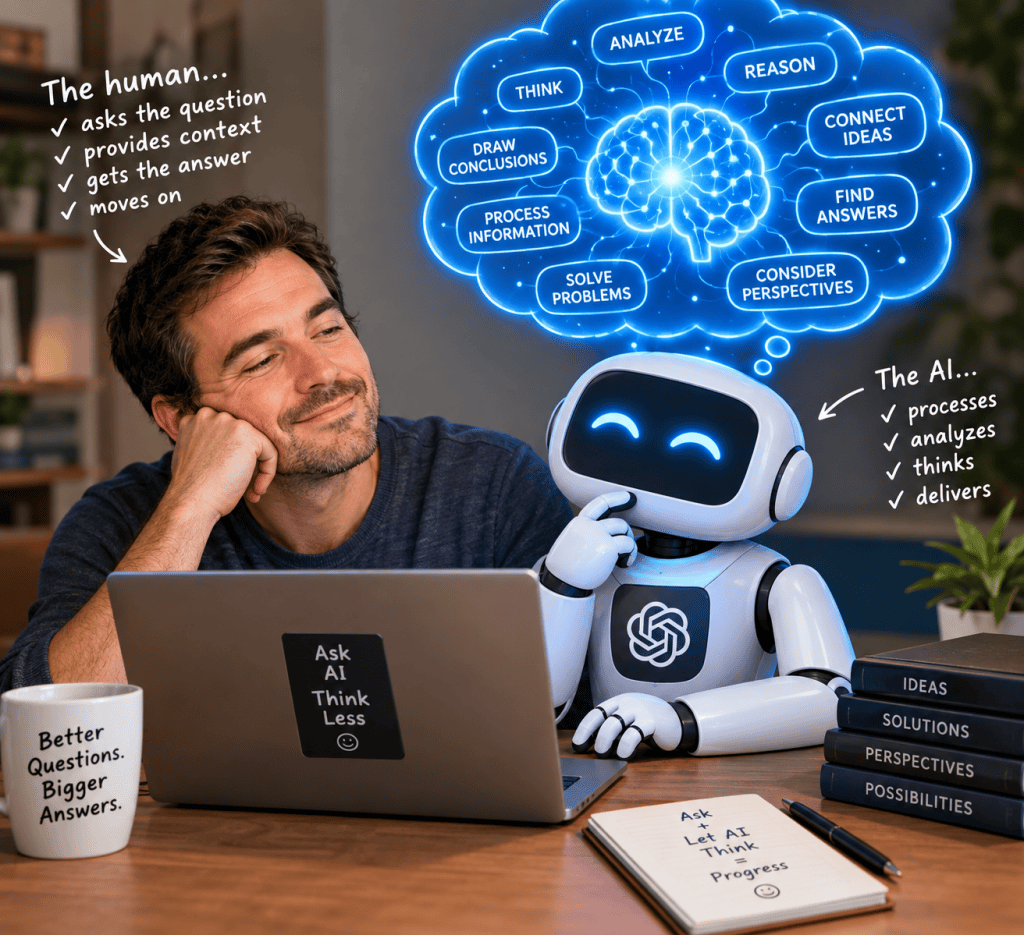
Using AI to Offload Thinking
Two newsletters arrived today, and each pointed to something that has the potential to remove this country from its prominent position as a world leader. Each newsletter decried the use of the modern technology called Artificial Intelligence (AI).
That in itself is nothing new. Every new technology ever invented has spawned its militant group of naysayers. Writing was a new technology at some point in human history, and Plato (in Phaedrus) made up a story of a god and a king with two different views on the art of writing.
Theuth was the god who invented writing and brought the invention to Thamus the king.
Theuth called it an elixir for memory and wisdom. He believed it would make the Egyptian people wiser and improve their memories by allowing them to record information. However, King Thamus called it a recipe for forgetfulness and false wisdom. He argued that people would stop training their memories and rely on external symbols instead of internal understanding. They would read a lot without proper instruction, appearing wise but remaining ignorant.
That argument didn’t stay buried in antiquity. In 2008, writer Nicholas Carr made a strikingly similar case about a much newer technology—the internet—describing a felt loss of his own capacity for deep, sustained reading and concentration (The Atlantic). Those who critique the use of AI today are making the same argument as Carr and Thamus before him.
My observation of the human condition over the past 50 years leads me to agree.
We are short-circuiting the
learning-memory connection.
I returned to university at the age of 47 to complete my undergraduate degree. Non-traditional students were no longer an anomaly on campus as there was a significant population of those who did not enter college straight out of high school.
However, I was floored by the mentality of the students who were in their late teens to 20’s having come straight from high school.
We were having a great discussion in our Intercultural Communications class. Students were engaged with the topic, interacting with one another and the professor when a hand shot up in the back of the room.
“Is this going to be on the test?”
This one example illustrates much of what I observed during my time at university followed by my time as a Middle-School teacher a few years later.
One of the newsletters had this significant statement—“…it concerns me that we shy away from common moral ground discussion of complex issues, defaulting to “does it work” arguments.”
Does it work? Does it get the job done? Does it produce the results we want?
Our educational system can be blamed for fostering this result-orientation rather than process thinking. I also include the parents in the concept of education, because many of them require teachers to basically “teach to the test.”
Teaching to the test has been the main accusation against teachers as they prepare their students for the end-of-year assessments. There is pressure from the top down to make a good showing with these assessments, because funding is tied to them.
However, “passing the test” has long been the goal for students in the education system.
Let’s be fair. Assessing the attainment of knowledge is a challenging process, and testing has been the default mode for decades. Good teachers will always have “extra credit” questions on the test. These assess the thinking ability of the students and how much effort they put into the learning process. These type questions usually require that the student has put thought into the material presented, not just memorized the study guide.
Study guides made it essentially unnecessary to learn during the class period, because the guide revealed what would be on the test. Therefore, all the student had to do was use the study guide and a good grade was probably assured. Learning is no longer the goal. Graduation is. And in order to graduate I need good grades. To get good grades all I have to do is learn the study guide.
It doesn’t seem to matter that after graduation I still have not learned how to think, how to put together a decent sentence, or do simple computations. I graduated. (Yesterday I couldn’t even spell graduwate and today I are one.)
Not having thinking skills is at the heart of the other newsletter. It was about AI in the classroom, and I will get to that in a moment. But first, another true-life illustration.
I was teaching a publications class in the middle school I mentioned. As a final project, I had the students write a news story. I allowed them to either use something local as their basis or to make one up from their imagination.
One student turned in a paper that I knew she had not written. This was before AI and it only took me about 10 minutes of searching the internet to find she had copied a news story from a newspaper in Oregan. I gave her a second chance.
Her trying to slide by with work not her own is indirectly a result of “the grade is all that matters.” With the load that is put on teachers today, it is becoming increasingly easier to get by with that sort of cheating. Teachers haven’t the time to think deeply about the work students submit.
Which brings up the problem of AI.
Students are now using AI to write their papers and do their research. The problem is that there are telltale signs of an AI generated paper. Consequently, students are turning to “AI humanizers” which purportedly make the AI piece sound more human.
Currently it is still somewhat easy to detect an AI product, but as the AI humanizers progress, it will become more difficult.
Because AI is at the forefront of our development today, it is necessary that we begin to teach AI literacy, the same way we had to teach internet literacy a few years ago. This literacy education should not be solely about how to use AI, but also include the ethics of its use.
As Carr warned, using AI to get the necessary work done short circuits the ability to think deeply. This will result in a retrogression of skills, which is potentially more devastating than simply getting caught using AI for the work.
The push to “git r done” with the only required methodology of “does it work” has become endemic among those entering the workforce. Ads for AI are targeting this group with ads that say things like, “My boss thinks I’m a superstar” or, “Get more work done than others in your office.”
In fairness, though, not every philosopher agrees that offloading equals decline. Andy Clark and David Chalmers argued in “The Extended Mind” that the mind was never confined to the skull in the first place—that a reliable external tool, consulted automatically and trusted the way we trust our own memory, effectively becomes part of our thinking rather than a substitute for it.
Their example was a notebook. But a notebook only holds what its owner put there. What the owner put in the notebook was their own thought. AI doesn’t hold your prior thought—it supplies thought you never had. That’s the difference that keeps this from being an extension of the mind, and starts looking like a replacement for it.
WHAT CAN BE DONE?
There are no easy answers to this insidious attack on the American work ethic. However, if it is not addressed and solved, we are on a downward spiral from the top of the heap. Our leadership of nations will soon be only of historical mention.
One area where we could start to influence a new generation is the classroom. Instead of assigning “work-at-home” projects, move everything to in-class assignments. Yes, this will require shorter essays, but they will be essays for which the student had to think.
That in itself would be a gain.
FULL DISCLOSURE:
I wrote the above article myself using my own thinking and the resources mentioned to spur those thoughts.
However, I have never been good at titles for my work. My editor at the newspaper always changed my headline for my articles.
I submitted this article to AI to help generate a title. Out of the 12 possibilities given, I chose the one above.
So, yes. While decrying the use of AI and its short-circuiting of the thinking process, I resorted to AI because I can’t think of a good title.


Leave a comment