Defined and Measured
What is success? How is it defined? How is it measured?
Over the years of reading, listening, and studying, I’ve noticed something very common: most people who want to be successful cannot say what that means to them. They have no clear picture of what their own success would look like. Without that picture, how would they ever know if they had arrived? I doubt they would.
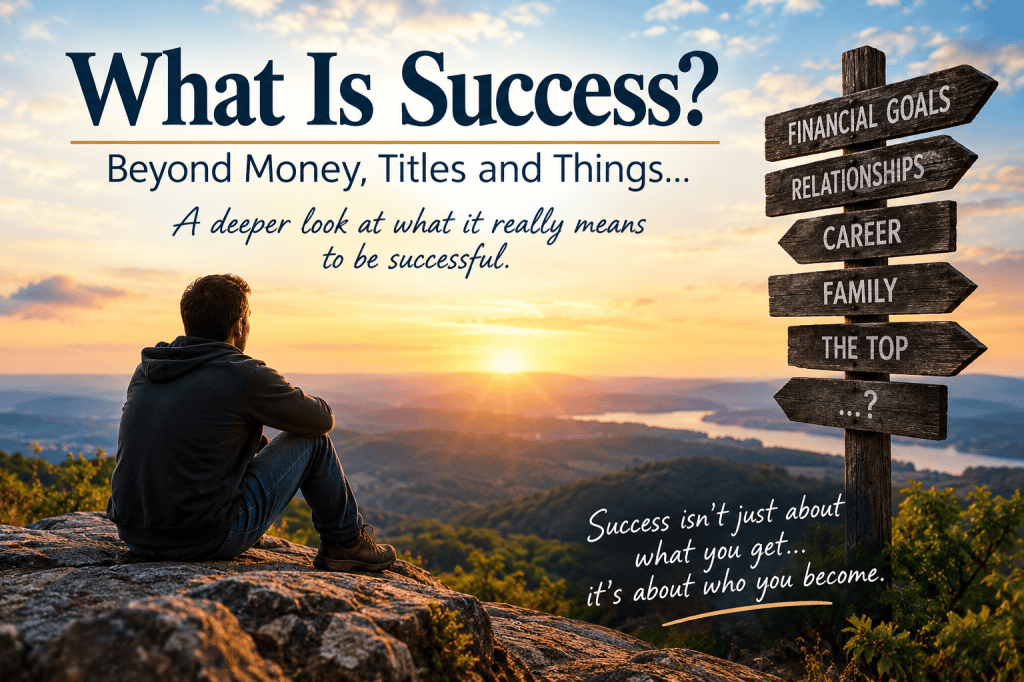
Our motivational voices lean hard on the need for clear goals: financial goals, relationship goals, career goals, family goals. Good advice, as far as it goes. But when I ask people what they actually want, the answers are usually foggy at best:
“I want to be successful.”
“I want to be rich.”
“I want a nice house.”
“I want to be at the top.”
Successful at what? How much money makes someone rich? What makes a house nice? At the top of what?
Nothing is wrong with those desires. But because they are undefined, the person can never know whether they’ve been achieved, and never knows which road to take toward them. Notice, too, that “rich,” “a nice house,” and “the top” are each just a different measure of success. So I want to deal with success itself, because when we truly understand it, every other goal becomes easier to reach.
The Problem With Measuring Success by Getting
Many people I talk with assume success means money. I want to propose something different. I want the person who will likely never have more than a month’s rent saved to know that success is open to them, even as the person who owns their rental can feel successful too. A definition that only the wealthy can meet is not a definition of success. It is a definition of wealth.
There is also a practical reason to doubt the tangible-goal definition: it doesn’t deliver what it promises. We assume that reaching the milestone brings lasting happiness. Psychologist Tal Ben-Shahar calls this the arrival fallacy: the illusion that reaching a long-sought goal will bring permanent satisfaction. Most of us have felt it, the strange emptiness after the promotion, the wedding, the graduation. Psychologists have a name for the mechanism underneath: hedonic adaptation. In a famous 1978 study, Brickman, Coates, and Janoff-Bulman found that people absorb good fortune quickly and drift back toward their baseline. That summit becomes the new ground floor.
Goals still matter, and the research is on our side here. Decades of work by Edwin Locke and Gary Latham show that specific, challenging goals improve performance far more than vague intentions or “just do your best.” So the vagueness I complained about is a real problem. But a goal is a milestone on the road. It is not the road, and it is not the destination.
The Butterfly
Success, like happiness, is an elusive butterfly. Chase it with a net and it flutters away. Sit still in a garden, and it may land on your shoulder. (That image is often credited to Nathaniel Hawthorne, but there is no verification from any of his writings.)
The chase has a cost. When we obsess over being successful, we breed anxiety, comparison, and a gnawing sense of lack. When we put our energy into good habits, honest work, and real relationships, the things we wanted tend to find us, and when they don’t, we are still better off for the effort.
There is a difference worth noting between these two ‘butterflies’. Happiness is largely internal, a state of the heart in the present moment. Success is usually external, measured by goals and achievements. We can build a net for success through discipline and strategy. But if we have no peace in us, a net full of achievements will feel hollow. That is the arrival fallacy again.
So true success must be something deeper than achieving a goal.
What the Ancients Knew
This is not a new problem. The wisest people of the ancient world kept returning to the same answer.
Aristotle called the highest human aim eudaimonia, usually translated “flourishing.” In the Nicomachean Ethics he argues that it is not a feeling or a possession but an activity: the life of the soul lived in accordance with virtue. Success, for Aristotle, is something you do, not something you get.
Socrates held that the unexamined life is not worth living. Measuring yourself against someone else’s scoreboard is the opposite of examination. You first have to ask what a good life is for you, and then be honest about whether you’re living it.
Epictetus, the Stoic, opens his Enchiridion by dividing the world in two: some things are up to us (our judgments, choices, and efforts), and some are not (reputation, wealth, outcomes). Anchor your sense of success to the second category and you hand your peace to the world. Anchor it to the first and no one can take it from you.
The Bible says the same, in its own way. Solomon in Ecclesiastes had every measure of success a man could want (wealth, wisdom, pleasure, achievement) and called it all “vanity” and a chasing after wind. Paul, writing from prison, said he had learned to be content in whatever state he was in.
In the parable of the talents, the master gives to each according to his ability. The servant who turned two talents into two more receives the same commendation as the one who turned five into five more: “Well done, good and faithful servant.” The measure was never the size of the return. It was faithfulness with what was given.
Which is exactly the thought I want us to sit with: doing the best we can with what we have.
What Modern Research Adds
Modern psychology keeps circling back to the same ground.
Harvard Business School professor Teresa Amabile and independent researcher Steven Kramer conducted a major multi-year study analyzing nearly 12,000 daily diary entries from 238 knowledge workers across seven different companies.
Their core finding—which they termed “The Progress Principle”—was published in a famous 2011 Harvard Business Review article and an accompanying book. The study definitively concluded that making consistent progress in meaningful work, even if it is just a “small win,” is the single most powerful driver of a positive “inner work life” (an employee’s daily mix of emotions, motivations, and workplace perceptions).
Edward Deci and Richard Ryan’s self-determination theory, built over decades of research, finds that people thrive when three needs are met: autonomy (acting from their own values), competence (growing in skill), and relatedness (connection to others). Notice what is missing from the list: net worth and title.
And the Harvard Study of Adult Development, which has followed participants for more than eighty years, points again and again to the quality of our relationships as the strongest predictor of health and long-term well-being. A man can climb to the top and still be poor in the one thing the study says matters most.
Making “Our Best” Measurable
Here is the honest objection to my own definition: “doing your best” can be as foggy as “I want to be rich.” If success is doing our best, how do we know when we have done our best?
I’d suggest three questions, asked regularly.
What is my best, right now? Be specific about your actual circumstances: your resources, health, season of life, and responsibilities. A single parent working two jobs and a retiree with free time do not share the same “best,” and neither should be judged by the other’s.
What would faithful effort look like this week? Break the large aim into practices you control: a habit kept, a conversation had, a skill practiced, a promise honored. These are measurable. You can look at Friday and say yes or no.
Am I better than I was? Not better than my neighbor. Better than my former self. Success is a personal standard, and the only fair comparison is to who you were prior to today.
Notice that this keeps what is good about goals. Set them, make them specific, and chase them. But treat each as a benchmark or milestone, and measure yourself by the faithfulness of the journey.
The Definition
For our purposes, then, success is “doing the best we can with what we have. Success is in the doing, not the getting—in the trying, not the triumph. Success is a personal standard—reaching for the highest that is in us—becoming all that we can be. If we do our best, we are a success.” (Wynn Davis)
Sit with that long enough and a remarkable thing becomes clear: there is no one for whom success is impossible. Not for lack of education, or the wrong country, or an empty bank account, or modest intelligence. Success, understood this way, is within reach of everyone who desires it, beginning today.
That is the purpose of this blog you are reading. Success is within your reach regardless of how you define it, and here you will find tips and insights designed to help you along your journey.
In order to be fully successful, it is necessary that we develop all three parts of our being as an integrated whole. You are spirit, soul, and body. Or, as some traditions have it, you are a spirit housed in a body who possesses a soul.
You will find articles here in KEYS TO SUCCESS that will help in each of these areas. Some things may already be a part of your character, while others may be something you’ve yet to recognize. Hopefully, if you have been on this journey for some time, you should find the articles to be an enhancement to who you already are.
Thanks for reading and engaging.
To be sure you don’t miss a thing, hit the SUBSCRIBE button to receive every new posting directly in your inbox. I promise you won’t be spammed with requests. I don’t release your name to anyone for any reason, and I am not setting you up for a series of sales pitches. I don’t appreciate that subterfuge anymore than you do, so I just won’t do it to you or anyone else.
Thanks again.


Leave a Reply