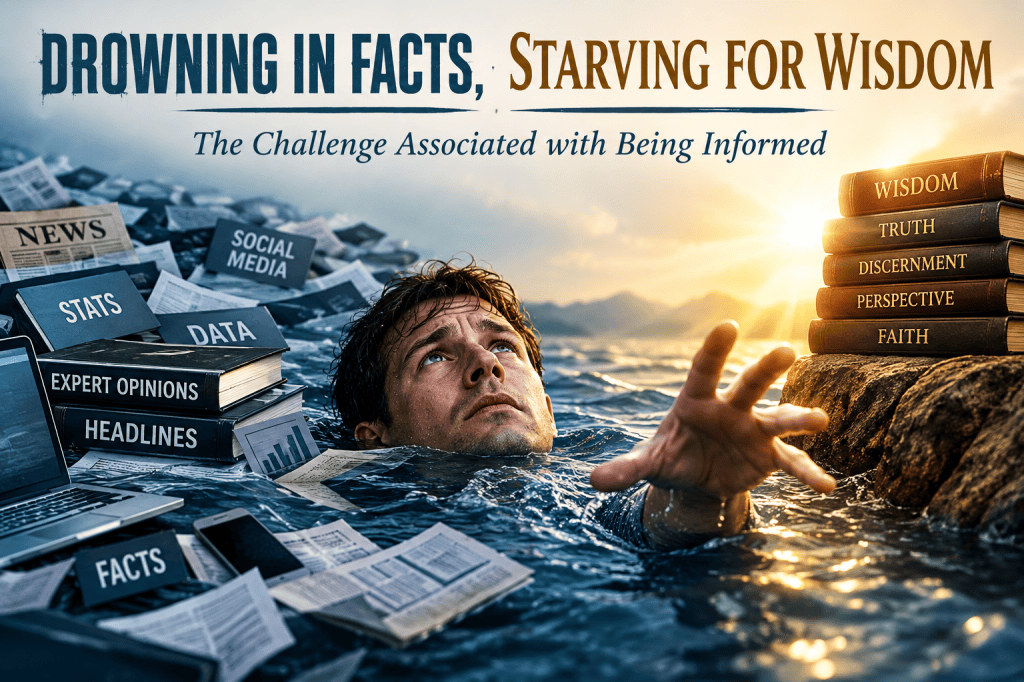
The Challenge Associated with Being Informed
No generation in history has had more information at its fingertips than ours, and few have been less sure what to do with it. The average phone today holds more data than the library at Alexandria ever did. Yet the person holding it can’t reliably say what they believe, why they believe it, or whether they chose even chose that belief.
Herbert Simon, a Nobel Prize-winning economist, saw this coming more than fifty years ago. Writing in 1971, he observed that a wealth of information creates a poverty of attention. That sentence is worth reading slowly. Simon wasn’t saying information is bad. He was saying that attention is the scarce resource, and that when you flood the world with one, you bankrupt the other.
A Wealth of Information
Creates a Poverty of Attention
My argument in this essay is simple, and I’ll state it plainly. Information abundance fragments attention. Fragmented attention starves reflection. And a people who cannot reflect are easy to steer. Wisdom is the remedy, but wisdom was never a matter of how much you know. It is the ability to apply what you know with understanding.
The Ancient Complaint
We like to think our problem is new. It isn’t. It is just louder.
Around the year 65, Seneca wrote to his friend Lucilius about reading. He warned that a multitude of books is a distraction, and that the man who is everywhere is nowhere. He recommended that a reader linger over a few trusted authors and digest them rather than wander through many. Seneca lived when books were copied by hand, and he already thought people were drowning.
Long before him, Heraclitus put it in a sentence: learning many things does not teach understanding. And Solomon, the writer of Ecclesiastes, who had every advantage of wealth, time, and royal access to knowledge, closed his book with this weary verdict: “Of making many books there is no end, and much study is a weariness of the flesh.” (Ecc 12:12 ESV)
These men were not anti-intellectual. Seneca read voraciously, Heraclitus was among the sharpest minds of his age, and the Preacher of Ecclesiastes tested everything under the sun. They were making a different point. Accumulation is not the same as comprehension, and the two may even work against each other.
From Abundance to Distraction
Consider how the mechanism works. When information was scarce, the hard part was finding it. You went to the library, wrote the letter, or walked to the sage. The effort itself filtered what you pursued, and it slowed you down enough to think about what you found.
Now the hard part is stopping. Information arrives unrequested, in endless supply, engineered to be consumed before it can be considered. The result is a mind that skims everything and sinks into nothing.
Proverbs describes this person with uncomfortable precision:
The discerning sets his face toward wisdom,
but the eyes of a fool are on the ends of the earth.
Pro 17:24
The man of understanding keeps wisdom in front of him, in focus. The fool’s gaze goes everywhere and settles nowhere. Scripture doesn’t call him ignorant. It calls him scattered.
Jesus diagnoses the same condition in Martha, a woman doing nothing wrong. She is serving, working, and hosting.
Martha, Martha, you are careful and troubled about many things:
But one thing is needful.
Luke 10:41-42
Her problem was not laziness or lack of information. It was a divided attention that couldn’t recognize the one thing that mattered. Many things, she had. One thing, she’d lost.
Paul gives the end state in a single phrase, describing people “ever learning, and never able to come to the knowledge of the truth“ (2 Timothy 3:7). Notice that this is not a description of the uneducated. It describes constant learners who never arrive.
The Death of Reflection
Why does fragmented attention matter so much? Because reflection needs a certain kind of time. You cannot weigh an argument you have only half-read, or test a claim you scrolled past in three seconds. Critical thinking is slow work. It asks you to hold a claim, ask where it came from, notice who benefits, compare it against what you already know, and sometimes sit in the ambiguity of not knowing.
Socrates made this the center of the philosophical life. At his trial, facing a death sentence, he said that the unexamined life is not worth living for a human being (Plato, Apology 38a). Examination is a discipline, and a discipline needs room. A culture that crowds out every quiet moment with another notification has not merely made us busier. It has made the examined life nearly impossible to practice.
Confucius understood both halves of the problem. “Learning without thought is labor lost; thought without learning is perilous” (Analects 2.15, Legge’s translation). {Note: there are many different translations of Confucius’ Analects; but the thought in this verse is essentially consistent among the ones that I could find.} Our age has plenty of learning—of a sort. What it lacks is the thought that must accompany it. We have the raw material for wisdom and no time to process it.
Who Benefits from a Distracted People?
I want to be careful here, because this is where the argument most easily turns into conspiracy theory. I don’t think a room of villains designed this. Most of the attention economy is probably driven by ordinary commercial incentives. Platforms profit from engagement, and engagement rewards whatever is fastest, loudest, and most emotional.
But the effect is the same whether it was planned or not, and the best thinkers on the subject see that control doesn’t require chains.
Neil Postman opened Amusing Ourselves to Death by contrasting the two great dystopian novelists, Orwell and Huxley. He said Orwell feared that what we hate will ruin us. Huxley feared that what we love will ruin us.
Postman believed Huxley had the better read on our situation, a world where truth is drowned in a sea of irrelevance and where people come to adore the technologies that undo their capacity to think. No one has to ban a book when no one wants to read one. Nobody must hide the truth when it is buried under a thousand trivialities.
Hannah Arendt made a related point about the deepest danger of sustained deception. Her observation was that the lasting damage is not that people come to believe the lies. It is that they lose the faculty by which they orient themselves in reality at all. A population that has stopped caring whether things are true is more governable than one that believes falsehoods, because a falsehood can at least be refuted. Indifference cannot.
That is the real meaning of “control of the masses” in the modern context. It is rarely a boot on the neck as in times past. More often it is a population too distracted, too exhausted, and too overloaded to ask the questions that would make it difficult to lead. Mental ennui becomes the normal cycle of response to any news.
Scripture offers the antidote, and it is not less information but better judgment. The Bereans earned a rare commendation because they “received the word with all readiness of mind, and searched the scriptures daily, whether those things were so” (Acts 17:11). Even the apostle Paul, an eyewitness to the risen Christ, was checked. Paul’s own instruction to the Thessalonians is the same: “Prove all things; hold fast that which is good” (1 Thessalonians 5:21). Testing is not disloyalty. It is the posture of a mind that refuses to be herded.
What Wisdom Actually Is
Now to the second half of the thesis. If information is not wisdom, what is?
Wisdom is the principal thing;
therefore get wisdom:
and with all your getting get understanding.
Pro. 4:7
Look at the second clause. Solomon doesn’t say, “with all your getting, get more.” He says, with all your getting, get understanding. Getting is assumed. Understanding is the point.
Epictetus gave us the best picture of it I know. He said sheep don’t bring up the grass to show the shepherd how much they’ve eaten. They digest it and produce wool and milk. In the same way, he told his students, don’t show off what you have read. Show what you have become because of it.
What have you become
because of your reading?
The test of knowledge is not display but transformation. A person who can recite a hundred facts about courage but runs from every hard thing has not been made wise by what they know.
This is why the writer of Hebrews describes the mature as those “who by reason of use have their senses exercised to discern both good and evil” (Hebrews 5:14). Discernment is trained by use. It is a muscle, not a warehouse.
Paul puts a sharp edge on the point: “Knowledge puffs up, but love edifies” (1 Corinthians 8:1). Knowledge without love inflates the one who holds it. Wisdom builds up. It is knowledge pointed outward, toward living well and serving others, rather than inward, toward the ego.
I should add a caution of my own against overcorrecting. Wisdom is not ignorance made respectable. Confucius insisted that thought without learning is dangerous, and Scripture treats the lack of knowledge as a real hazard, as in Hosea’s lament that “My people are destroyed for lack of knowledge” (Hosea 4:6).
A fool with no facts is no wiser than a fool with too many. The wise person needs knowledge, but needs it ordered, weighed, and applied. Knowledge is the timber, and wisdom is the craft of building something that stands.
The Psalmist asks for exactly this.
So teach us to number our days,
that we may apply our hearts to wisdom
Psalm 90:12
Apply is the verb that matters, the same one at the center of any honest definition of wisdom. Not collect, not accumulate, not even understand in the abstract. Apply.
Practicing Wisdom in an Age of Noise
If this diagnosis is correct, the response is not to abandon information. It is to recover the conditions in which wisdom grows. A few practices follow from the sages we’ve heard.
Subtract. Lao Tzu wrote that pursuing learning means adding something every day, while pursuing the Way means subtracting something every day (Tao Te Ching 48). Most of us need a ruthless audit of inputs. Fewer feeds, fewer voices, fewer alerts. Seneca’s idea of a few trusted authors beats a thousand skimmed ones.
Read slowly, and less. Choose a book and stay with it. Underline, argue with it, and return to it. Digest rather than devour, as Epictetus’s sheep do.
Test what you hear. Adopt the Berean habit. Before you accept or share a claim, ask where it came from, who gains from it, and whether it is true. Make “whether those things were so” a reflex.
Protect silence. “Be still, and know that I am God” (Psalm 46:10). Stillness is not a luxury for monks. It is the soil in which understanding takes root. Without it, nothing you learn can settle.
Apply what you know. Take one thing you learned this week and act on it. Wisdom, remember, is knowledge applied with understanding. If it never leaves your head, it was only information.
The Choice Before Us
The old sages and the modern critics converge on the same warning. A people who are overloaded with information and starved of reflection will not usually be conquered by force. They will drift, distracted and agreeable, toward whoever manages their attention best.
The answer is not to know less but to become more than a container for facts. It is to become people who pause, weigh, test, and then act. The Socratic life, the Proverbial life, the life of the Bereans, were all, in their different ways, lives of attention. Each learned to ask what a thing means and what should be done about it, and not only what is being said.
Information will continue multiplying. That is no longer in our control. What remains in our control is whether we meet it as fools with eyes in the ends of the earth, or as people with understanding who keep wisdom in front of them.


Leave a Reply