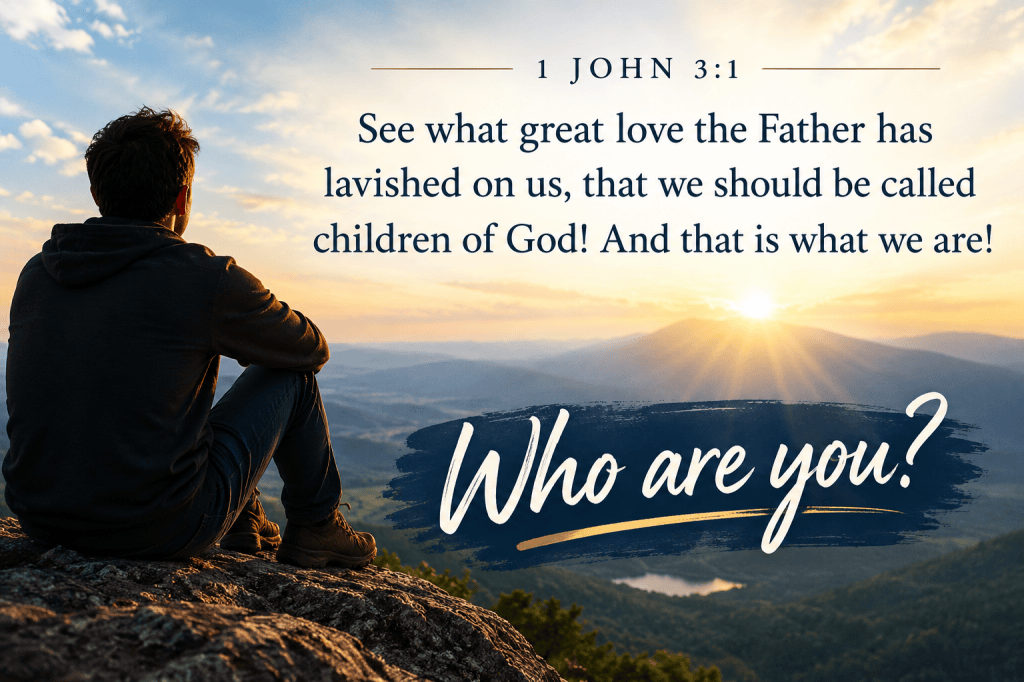
Knowing who you are makes for a steady life.
NOTE: An expanded video version, including a testimony from my wife, is available here.
Do you know who you are? That’s not a small question. It’s the question underneath almost every other question you will ever ask. Every argument you’ve had, every sleepless night, every time you’ve looked in the mirror and wondered whether you measure up — all of it is really asking one thing.
Who am I?
Who are you?
When most people are asked that question, they tell what they do. I’m a teacher, a lawyer, a pastor, an accountant, a stay-at-home mom, etc. When pressed further, they usually go to what has happened to them. I’m divorced; I lost a company; I’m a widow; I’m a survivor. Many people go through life never knowing who they really are and probably never give it much consideration.
Some of us reach a place where we are overwhelmed with the reality that we don’t know who we are. That happened to me when the mother of my children left. I had no idea who I was or what I was supposed to do or be. I felt lost.
It took me many years to come out of that fog. Returning to my love for the written word of God helped put me back on a good path.
John says that we are the children of God. He doesn’t say we are what we do, or what was done to us.
Child of God is a present fact, given by the Father before we earned anything.
If you take hold of it, that truth steadies everything else.
See what kind of love the Father has given to us,
that we should be called children of God; and so we are.
The reason why the world does not know us is that it did not know him.
1Jn 3:1
Beloved, we are God’s children now,
and what we will be has not yet appeared;
but we know that when he appears we shall be like him,
because we shall see him as he is.
And everyone who thus hopes in him purifies himself as he is pure.
1 Jn 3:2-3
There are four truths in these verses we should see.
I. The Love That Makes Us Children (v. 1a)
John opens with a command: “Behold.”
He isn’t telling us to glance at this love. He is telling us to stand still and stare at it. He is not reporting information. He is pointing at something so large that if you walk past it without stopping, you’ve missed the whole point of your life.
Now, notice that John doesn’t say the Father made us servants. He doesn’t say the Father made us employees, or volunteers, or even followers. He says children.
And the word he uses for love is a love of a different kind — a love that doesn’t fit into any category we already have. This love was not earned. It was bestowed.
That’s a gift word. You don’t qualify for a gift. You receive one. And when you receive it, it doesn’t just change your standing. It changes your name.
Do you remember what happened to Jacob? He wrestled all night with God and walked away with a limp and a new name — Israel. Do you remember what happened to Abram? God changed his name to Abraham before a single promise had been fulfilled. Do you remember Simon, the impulsive fisherman who denied he even knew Jesus? Jesus looked at him and said, you are Peter, and on this rock I will build my church — and He said that knowing full well what Peter was going to do on the worst night of his life.
The phrase “what manner of love” translates a Greek word, potapos, which at root means “from what country?” John is saying this love isn’t native to our world. We have no category for it, because nothing in this fallen world produces love like it.
How did we become children?
John’s Gospel tells us it was a gift, not an achievement:
But to all who did receive him, who believed in his name,
he gave the right to become children of God,
who were born,
not of blood nor of the will of the flesh nor of the will of man,
but of God.
Jn. 1:12-13
Not of blood, so no family line earns it. Not of the will of the flesh, so no effort earns it. Not of the will of man, so no religious program earns it.
It is born of God.
And the Father did not decide this reluctantly.
Paul says it was God’s delight, and that it was settled before we ever existed:
…even as he chose us in him before the foundation of the world, …
In love he predestined us for adoption to himself as sons through Jesus Christ, according to the purpose of his will,
Eph. 1:4-5
Good pleasure. God did not adopt us grimly, as a duty. He wanted us.
Christianity is not about moral rectification. It’s about a heart condition. And this is exactly why.
If you believe you are an orphan, you will spend your whole life trying to earn a place at a table that already has your name on it. But if you know you are a son or a daughter, you will sit down and eat.
We can blame ourselves for not measuring up. We can blame our parents for what they didn’t give us. We can blame the church for the way it treated us. We can spend our whole lives auditioning for a love that has already been given.
But you cannot audition for a family.
You’re either in it or you’re not. And John says you’re in it.
Jesus gave us a picture of how the Father receives people. The prodigal son rehearsed his speech in the pigsty, but his father never let him finish it:
I will arise and go to my father, and I will say to him,
“Father, I have sinned against heaven and before you.
I am no longer worthy to be called your son.
Treat me as one of your hired servants.”‘
And he arose and came to his father.
But while he was still a long way off,
his father saw him and felt compassion,
and ran and embraced him and kissed him.
Lk. 15:18-20
Understand this: the Father ran. He didn’t run from the son; he ran toward him.
If you have wondered whether God is reluctant toward you, look at the road. He is coming down it straight to you.
The son’s confession included a denial of his true identity, but his father would have none of it.
Sadly, many people are not able to recognize their true identity.
Not only that, but others also cannot see who you really are, which brings us to the second truth.
II. The Identity the World Cannot Recognize
John adds something sobering:
The reason why the world does not know us is that it did not know him.
1 Jn. 3:1b
The reason the world does not know us is that it does not know him. If you are a child of God, don’t expect the world to understand you. It has never understood your Father, and it doesn’t understand your Elder Brother.
Jesus told his disciples plainly:
If the world hates you, know that it has hated me before it hated you.
If you were of the world, the world would love you as its own;
but because you are not of the world,
but I chose you out of the world,
therefore the world hates you.
Jn. 15:18-19
This should free us from a certain kind of tiredness. Many believers spend their lives trying to win the world’s approval, and when it isn’t given, they wonder what is wrong with them. But if the world does not know the Father, it cannot recognize the Father’s children. The lack of recognition is not a verdict on us. It is a family resemblance that the world can’t read.
And while the world fails to recognize us, God’s Spirit confirms who we are from the inside:
For you did not receive the spirit of slavery to fall back into fear,
but you have received the Spirit of adoption as sons,
by whom we cry, “Abba! Father!”
The Spirit himself bears witness with our spirit that we are children of God,
and if children, then heirs–heirs of God and fellow heirs with Christ,…
Rom. 8:15-17
Abba.
That is the word of a child, not a servant. A servant says “sir,” but a child says “Daddy.”
The Spirit teaches us to use the child’s word, and Paul says elsewhere that this changes our whole standing:
So you are no longer a slave, but a son,
and if a son, then an heir through God.
Gal 4:7
Let the world misjudge you, then. The Father’s opinion is the one that counts, and he has already spoken.
This brings us to the third truth, which is something I have tried in the past to make clear even though it is difficult to understand.
III. The Now and the Not Yet (v. 2)
Here is one of the most remarkable sentences in the New Testament:
Beloved, we are God’s children now,
and what we will be has not yet appeared;
1Jo 3:2a
Understanding the now and not yet aspects of our salvation and perfection in the Lord is a challenge for the mind which requires a yes/no, black/white, right/wrong kind of world. Yet it is a truth which should be grasped.
Notice the two aspects of time running at once. We are children NOW, fully and truly, with no probation period. But it does not yet appear what we shall be. The family resemblance is real, but it is not yet complete.
You may look in the mirror and see unfinished business: old habits, old wounds, a faith that seems strong on Sundays wobbles on Tuesdays.
John does not deny it. He says the picture isn’t finished, but the Father is the artist, and he knows what he is making.
Paul tells us the plan:
For those whom he foreknew
he also predestined to be conformed to the image of his Son,
in order that he might be the firstborn among many brothers.
Rom 8:29
The goal is nothing less than the likeness of Christ.
And Paul describes the day it arrives:
Our citizenship is in heaven,
and from it we await a Savior, the Lord Jesus Christ,
who will transform our lowly body to be like his glorious body,
by the power that enables him even to subject all things to himself.
Phil. 3:20-21
John says that what changes us is a sight: “we shall see him as he is.”
Seeing becomes becoming. What you focus on is the direction you will grow.
Today our vision is partial:
For now we see in a mirror dimly, but then face to face.
Now I know in part; then I shall know fully,
even as I have been fully known.
1Co 13:12
Notice the last phrase, “even as I have been fully known.” God already knows you completely, and he has not changed his mind about adopting you. One day you will know him in the same way. The child will see the Father’s face.
So if you are discouraged by how far you still have to go, hear this.
Your unfinished state doesn’t cancel your sonship. You are not a child who might become one if all goes well. You are a child who is being made like his Father.
And that knowledge helps us to stay the course to fulfill the fourth truth.
IV. The Hope That Cleans House (v. 3)
And everyone who hopes in him purifies himself as he is pure.
1Jo 3:3
Look carefully at the order.
John doesn’t say, “Become pure so that you may become God’s child.” He says that because you are God’s child, and because you hope to see him, you live differently. Identity comes first, and behavior follows.
That is the exact same thing I told you last week.
Get that backward and we spend our lives trying to earn what we have already been given.
Think of a young man engaged to be married. He doesn’t keep himself faithful in order to be loved. He does it because he is loved, and because the wedding day is coming. Hope makes him want to be ready.
So it is with us. A person who truly expects to see Christ cannot be casual about sin.
Jesus promised:
Blessed are the pure in heart: for they shall see God.
Matt. 5:8
Purity here is not mere rule-keeping. It is a heart whose gaze has become fixed on one thing. And that purity is the family character, the habit of a child who takes after his Father. “Even as he is pure”: we are not measured against our neighbor, but against the Father’s own life, which we have been invited to share.
Notice also that John says we purify ourselves by hope. It is not grim willpower. It is a joyful longing that cleans house because Someone is coming.
I want to conclude by coming back to the opening word.
Behold.
Behold the love,
…which is foreign to this world and ran to meet you on the road.
Behold the identity,
…which the world cannot read but the Spirit confirms in your heart.
Behold the promise,
…that what you will be is not yet visible, but you will be like him.
Behold the hope,
…which makes a person want to be clean for the day he appears.
You may have never called God “Father,” but the invitation of John 1:12 is still open: as many as received him.
Receive him today.
Others have called him Father for years but have forgotten what that means. You’ve been living as a servant, afraid, working for approval. Hear the Spirit again: Abba.
You are not an orphan. You are not on probation. You are a child.
Get this settled: whatever else the week holds, whatever the world says, whatever we have done or failed to do, the Father has already named us.
“Now are we the sons of God.”
So let me ask you again.
Do you know who you are?
If you are in Christ, you are not what the world calls you.
You are not what your worst day calls you.
You are not what your family history calls you.
You are a child of the Father, adopted by a love you did not earn and cannot lose, and you are being made into something you cannot yet see.
So stop standing outside the door.
Stop trying to earn your way in.
The table is set, and your seat has been waiting for you the whole time.
Behold what manner of love the Father has bestowed on us.
It’s right there within you, so embrace it.


Leave a Reply