Paul did not hide a secret teaching in his letter
NOTE: A much expanded video version can be found here.
The Bible is an amazing book. It is a series of books written across hundreds of years and collected into a single volume for us. As a single volume, it is an anthology—a collection of writings on a theme, which in this case, the theme is God’s dealings with humans and how humans relate to God.
The collection of 66 books we have today is the result of more than a few centuries of dialogue and dispute over the ones that should be included as official. Not only has the collection itself been disputed, but also the correct translation from the available manuscripts.
There are approximately 900 different English translations of the Bible and parts of the Bible. Only about 70 are widely considered today by major digital platforms like Bible Gateway, E-sword, and Blue Letter Bible. Couple this multitude of translations with more than 40k denominations and there is no question why the world thinks we are a mixed up bunch of lunatics.
Not only is there this type of confusion, but there are also those who maintain that they belong to the only true church, or have the only true version of the Bible.
Should we be concerned about our affiliation with the correct denomination or the correct translation of the Bible?
Without equivocation, my answer is NO.
The plethora of denominations, the multitude of translations and the abundance of modern recommendations does not prove that God is unable to protect His word. There are those who want to argue for a need to defend the Bible as God’s Word in order to protect it from abuse, misuse and non-use. So far, they have been unsuccessful in their endeavors to protect God from what they view as His enemies.
I can assure you this morning, that if each church in our town was to use the same passage of scripture that I will be using, we would hear different and maybe even contradictory interpretations. I would not label any of them as being against God.
The difference is only a problem to those who try to learn from too many different teachers.
God placed teachers in the church, of that we can be sure.
And he gave the apostles, the prophets, the evangelists,
the shepherds and teachers,
Eph 4:11
We are not told anywhere that there will be consistency among those who teach. Paul’s consistent call for unity among believers does not necessarily mean they should all believe the same about everything.
There is only one main fundamental point of which we should all agree.
Jesus is Lord and above Him there is no other.
Paul rebuked the Corinthian church for dividing themselves in favor of particular teachers.
I fed you with milk, not solid food, for you were not ready for it. And even now you are not yet ready, for you are still of the flesh.
For while there is jealousy and strife among you, are you not of the flesh and behaving only in a human way?
For when one says, “I follow Paul,” and another, “I follow Apollos,” are you not being merely human?
What then is Apollos? What is Paul?
Servants through whom you believed, as the Lord assigned to each.
I planted, Apollos watered, but God gave the growth.
So neither he who plants nor he who waters is anything, but only God who gives the growth.
1 Cor. 3:2-7
The fact that people were lining up behind one teacher or the other should reveal that there were possibly differences in what they were teaching. Of course, it could just as easily have been the style of teaching to which people were drawn.
If Apollos wrote anything, it is not available to us today. However, Paul wrote quite a lot and much of his writing made its way into the Bible. Even if we were to consider only Paul’s writings, we would still find a myriad of interpretations of what he actually meant.
I want to take one of those passages from Paul’s letters which has provided us with some controversy over the years.
But we do not want you to be uninformed, brothers, about those who are asleep, that you may not grieve as others do who have no hope. For since we believe that Jesus died and rose again, even so, through Jesus, God will bring with him those who have fallen asleep.
For this we declare to you by a word from the Lord, that we who are alive, who are left until the coming of the Lord, will not precede those who have fallen asleep. For the Lord himself will descend from heaven with a cry of command, with the voice of an archangel, and with the sound of the trumpet of God.
And the dead in Christ will rise first.
Then we who are alive, who are left, will be caught up together with them in the clouds to meet the Lord in the air, and so we will always be with the Lord. Therefore encourage one another with these words.
1 Thess. 4:13-18
The very first thing we should notice in this passage is its intent.
Paul is not trying to build a doctrine of last things here as much as he is trying to encourage those who were concerned about their loved ones who had died before the Lord’s return. He says he does not want his readers to be uninformed about those who have died. So he explains what will happen to them in the future.
Then notice the very last line.
“Encourage each other with these words.”
The entire passage is to those who were wondering about their believing family members who had died. What about them? Paul explains that we will not be with the Lord without them alongside us.
That was his intention when writing. He wanted to clear up a misunderstanding. However, that is NOT how the passage has been used.
There are some who find in this passage a doctrine of soul sleep. “Soul sleep” is the theological belief that when a person dies, their soul enters a state of total unconsciousness rather than going immediately to heaven or hell. This becomes a major doctrine of some denominations to which adherents must subscribe in order to be considered faithful.
However, soul sleep does not produce the controversy that v. 17 produces.
Then we who are alive, who are left,
will be caught up together with them in the clouds to meet the Lord in the air,
and so we will always be with the Lord.
1Th 4:17
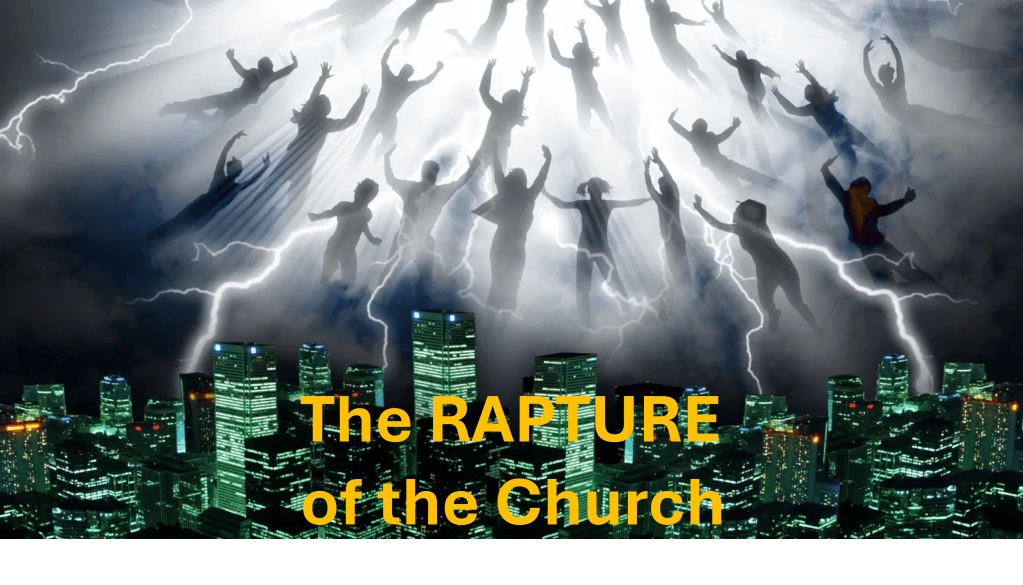
This verse is the foundation of the teaching called the Rapture of the Church. In a nutshell, this doctrine states that the church will be removed from the earth in a secret event before the return of the Lord to rule over the earth. Its adherents keep the Rapture closely tied to the Great Tribulation supposedly scheduled close to the end of time, though they vary as to its exact timing.
Interestingly, this teaching in any form was never heard of for the first 1800 years of the church. For the first 1,800 years of the church, Christianity overwhelmingly taught a single, visible, and public second coming of Christ.
There were early hints of this thinking from a couple of theologians in the 18th century, but it was formalized by JN Darby about 1830. He heard of a vision by Margaret MacDonald, who attended a church pastored by Edward Irving. Darby then developed the theory of Dispensationalism as a means of interpreting the Bible.
His theory was popularized by CI Scofield and his reference Bible, DL Moody and Dallas Theological Seminary. The Rapture theory has now become the cornerstone of modern American evangelicalism.
I support the idea of a progressive revelation in understanding the Bible, and this would fit into that concept. Progressive revelation though, should not undermine the general tenor and theme of the Scriptures.
Let’s take a few moments to look at the foundational verse and a couple of supporting verses.
V. 17 speaks of those who are still alive on the earth at the time of this secret event. It says they will be “caught up.” That phrase—caught up—translates a Greek word ‘harpazo,’ which means to take by force. There is a forcible physical event in this being caught up into the clouds.
The next two phrases are the most interesting. We will be caught up
to meet the Lord in the air, and so we will always be with the Lord.
Reading this as it stands, one can easily understand the Rapture teaching. We get snatched from the earth to meet the Lord in the air and we will always be with Him after that. However, an important element is missing in our English language and an assumption is based on this element.
The assumption comes with the word ‘meet.’ We use that word in English to describe a few different scenarios.
On the highway, I meet oncoming traffic. We meet without stopping and continue in our different directions. When we come to church, we meet with others and stick around for awhile. When you come to my house and knock on the door, I come out to meet you and we go back inside.
It is this last concept used as ‘meet’ for the Greek word.
Vine’s Expository Dictionary is a layman’s reference book for a basic understanding of how Greek words are used. It is not some back of the bottom shelf book used by only a handful of weird teachers. It is the standard used and recommended by every major seminary and theologian for the student who never goes beyond their kitchen table in education of te Bible.
This is Vine’s treatment of the word ‘meet’ as used in 1 Thess. 4:17.
It is used in the papyri of a newly arriving magistrate.
It seems that the special idea of the word was
the official welcome of a newly arrived dignitary.
(Strong’s G-529)
Vine’s is tied to Strong’s Exhaustive Concordance, which is another basic reference book for the person who does a litttle more than just read the Bible.
Where is that newly arriving magistrate going once he is met at the city gate? He’s going into the city, which is where he was aiming in the first place.
What Paul wrote in the Greek language was that when the Lord returns to the earth, those who are alive will be joined by those who have died, and together they will go up to meet the Lord on His way to the earth. They are not staying in the air or going on up to heaven.
One of the major reasons given for the Rapture is to escape the Great Tribulation as mentioned in Matthew and the Revelation.
For then there will be great tribulation,
such as has not been from the beginning of the world until now,
no, and never will be.
Matt 24:21
The belief is that no one will survive this great tribulation, so the church cannot possibly be here during that time. Therefore, the rapture is necessary to remove the people of God.
There are also a few supporting verses for the theory, but we will look at only one at this time.
For as were the days of Noah, so will be the coming of the Son of Man.
For as in those days before the flood they were eating and drinking,
marrying and giving in marriage, until the day when Noah entered the ark,
and they were unaware until the flood came and swept them all away,
so will be the coming of the Son of Man.
Matt. 24:37-39
This passage is used to show that the church will be removed from the catastrophic events of the tribulation. The flood came and swept away all the wicked while Noah and his family were spared.
A simple truth is missed, though.
Noah was in a boat in the midst of the flood and storm.
Most who espouse the Rapture say that the people of God cannot make it through the Great Tribulation. They unwittingly admit that God and God’s people are too weak to handle such an event. But that is not what we see in the Bible.
Daniel was thrown into the lion’s den and survived. The three Hebrew children in Daniel were thrown into a fire and they survived. The Jews were in Egypt for the ten plagues, yet they did not suffer. None of these were removed from the trial. They were fully present yet unharmed.
And that is what Peter says about Noah.
because they formerly did not obey,
when God’s patience waited in the days of Noah,
while the ark was being prepared,
in which a few, that is, eight persons,
were brought safely through water.
1Pe 3:20
The people of God who are alive for the Great Tribulation will be brought safely through.
It is true that I do not personally believe in the Rapture. I was told once that since I didn’t believe in it, I wouldn’t get to go. I’m not so sure about that.
For those who do believe in the theory of the Rapture, that is okay, too.
In fact, Paul tells us to use this passage to comfort one another about our loved ones who have passed.
Therefore comfort one another with these words.
v.18
We can use the words without trying to explain them or build a doctrine, and let the person who hears them do what they will with them. The passage was written not to divide the church, but to encourage and comfort one another.
Therefore,
be encouraged about your loved ones
who have gone before you.


Leave a Reply